For the last 20 years, search and marketing on the Internet have been dominated by SEO, or Search Engine Optimization. Most of us old enough to remember Google's launch in 1998 recall how quickly it took over. It spread like wildfire. I remember using it for the first time in the summer of '99 and thinking, “How can it be this good?”
Then, in early 2023, I heard about ChatGPT. The first time I tried it, it gave me that same rush from Google 23 years earlier…but with a sprinkle of magic. ChatGPT felt like a blazing inferno.
The British science fiction writer Arthur C. Clarke once said, “Any sufficiently advanced technology is indistinguishable from magic.” Modern AI tools often feel magical because they're that powerful. They're going to change the world in ways we can't yet imagine.
New technologies shift things at the edges. They don't uproot industries overnight but nibble away at the vulnerable parts over years. Looking back, it seems sudden, but living through it, you barely notice. AI is like the Internet in 1996. Something big was brewing, but we didn't grasp its scale until two decades later.
AI will transform digital marketing the same way digital marketing overhauled pre-Internet approaches. One key area it's reshaping right now is SEO. The SEO industry is huge, valued at around $80 billion in 2024.
The GEO Overlords Have Arrived
There’s a PPC marketing agency called Eight Oh Two that studied how AI is changing search. They found that in 2025, 37% of people started searches with AI instead of Google. While that may not sound huge, remember how dominant Google has been for two decades. For the longest time, if you didn’t rank on Google, your business was invisible, and entire industries sprang up around that.
There’s good reason to believe AI will eat up a much larger share of search (including Google’s own AI tools) because traditional search engines have built-in deficiencies. When they first arrived in the 1990s, they competed with the physical world of atoms, where info is stored on paper. Google brought us into the world of bits, where information isn’t limited by physics. But that created a new problem: too much information. The search/social media era of the 2010s was defined by information fatigue. How do you know what’s good info? Search engines were invented to solve that.
But as I mentioned, they have deficiencies. People are turning to AI to escape what traditional search has become. If you ask most people their top frustrations with search engines, they’ll say:
• Clicking through too many links
• Too many ads and sponsored results
• Difficulty getting a straight answer
• Repetitive or low-quality information
Really, it all boils down to time. People feel like search engines waste too much of it, while AI synthesizes info and puts it right in front of you. Most of us consider time our most valuable resource.
Because of this, AI search will keep gaining steam, especially as today’s young people enter the workforce in the coming years.
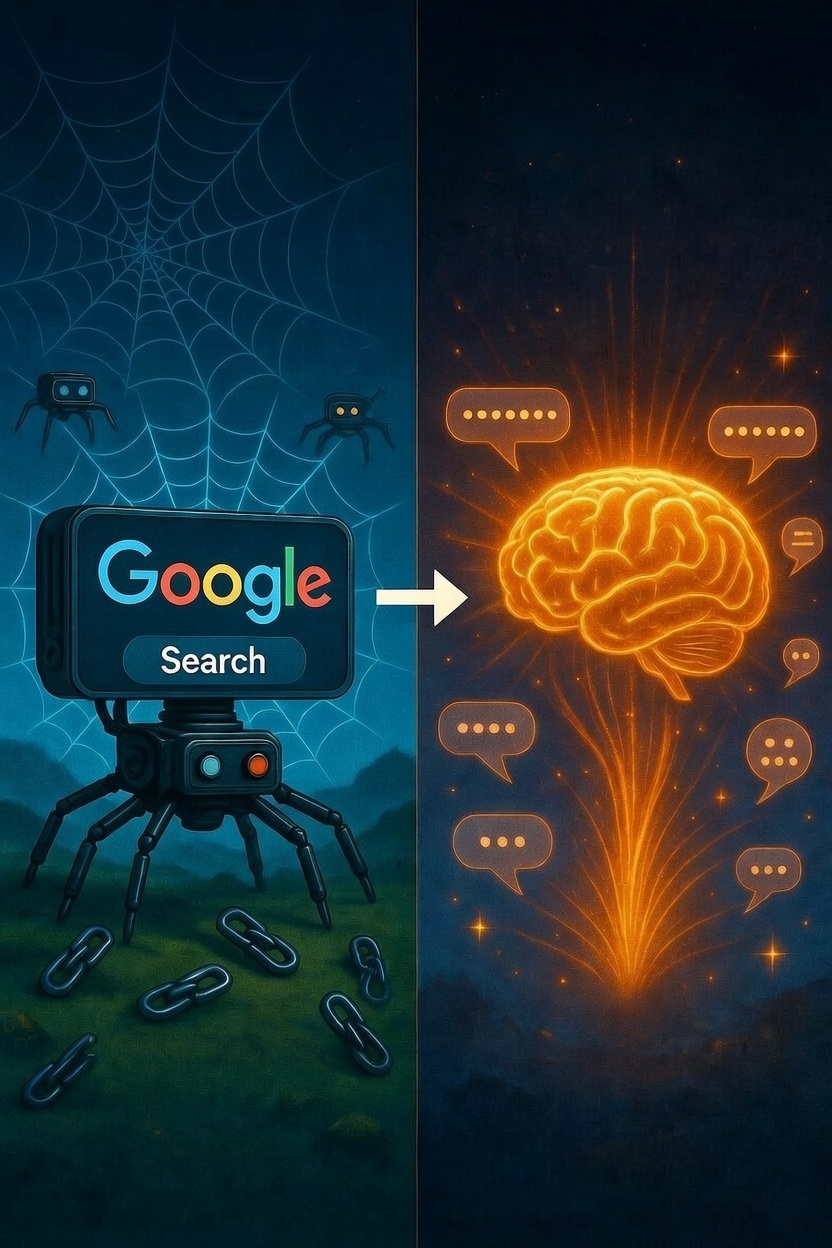
AI vs GoogleSearch—How They Work
AI and Google search take different approaches to finding and presenting information. Google search is built around links. It crawls, indexes, and ranks pages, assuming you will scan results and piece together the answer yourself. Each query is treated in isolation, and the system forgets everything as soon as you hit “Enter.”
AI search changes that. It uses large language models (LLMs) to interpret natural language, keep track of context, and generate direct answers with citations, all in one step.
HOW DOES GOOGLE SEARCH WORK?
Crawling: Google's web crawlers scan billions of pages across the internet. These automated programs follow links from page to page, collecting text, images, and other content. Crawlers continuously discover new and updated content.
Indexing: After crawling, Google processes and organizes the information. It removes duplicate content, extracts metadata from title tags and anchor text, and organizes everything into an inverted index. This data structure maps keywords to documents, enabling rapid retrieval when you search.
Ranking: When you do a Google search, Google applies hundreds of signals to determine which results to show and in what order. Core ranking factors include keyword relevance, domain authority, backlink quality, content freshness, and user engagement metrics. Search Engine Optimization is directly tied to ranking. It’s how businesses get their content to show up first.
AI Overviews: Google now generates AI-powered summaries at the top of many search results. These overviews use the same indexed content. Gemini synthesizes answers by pulling from pages Google has already crawled and ranked. The underlying mechanics remain unchanged: crawl, index, rank. The AI layer sits on top, summarizing what the index already contains rather than reasoning across live sources in real time like other generative AI platforms.
This whole process determines what you see when you do a Google search. It’s highly advanced, but quite different from what AI search platforms do. One of the reasons I believe Google can’t win the AI race is because their entire technology foundation still begins primarily with keywords rather than natural language understanding. They won’t disappear, but they will probably be reduced to what IBM has become today over the next decade.
HOW DOES AI SEARCH WORK?
AI search has completely changed how search works because instead of returning pages of links, it provides synthesized answers that directly address your questions. Whereas traditional search engines match keywords to pages, AI platforms understand the context of sentences and provide specific answers with semantic richness.
But how do they do this?
Large Language Models, or LLMs, power this by processing searches in full sentences rather than just key terms. This introduces a level of semantic understanding which lets you ask questions like “Where does the DNA code come from?” without breaking it up into keywords.
Retrieval Augmented Generation
The “search, click, read, back, repeat” loop that we’re all getting so tired of evaporates with AI search because of Retrieval Augmented Generation (RAG). It sits at the core of accurate AI search. It’s what makes it so much more effective than traditional search.
RAG is a technique that grounds LLM responses in specific, relevant documents rather than relying solely on the model's training data. So, when you ask a question, here’s what happens:
1) Retrieves relevant documents from web content, internal repositories (private RAG), or specialized databases
2) Feeds these documents to the LLM as context
3) Generates a synthesized answer with citations to the source material
This is why answers can be so accurate and feel human-like.
The Impact of AI Search on Business
As we go from SEO to GEO, businesses will have to focus much more on content quality. Because AI engines rely more on content context than traditional search does, content quality is going to be more important to get selected by AI platforms. Companies now must optimize for accurate representation in AI-generated answers rather than maximizing click-through rates. While website traffic volume may decrease, the shift prioritizes conversion quality over raw visitor counts.
An effective content strategy in this environment requires creating machine-readable information with a clear structure. Detailed FAQs, comparison tables, and expert analyses with proper attribution become critical. Content must serve dual purposes: supporting both AI extraction and human comprehension.
Content authority and quality now matter more than ever.